Tuwo gero — Millet Paste
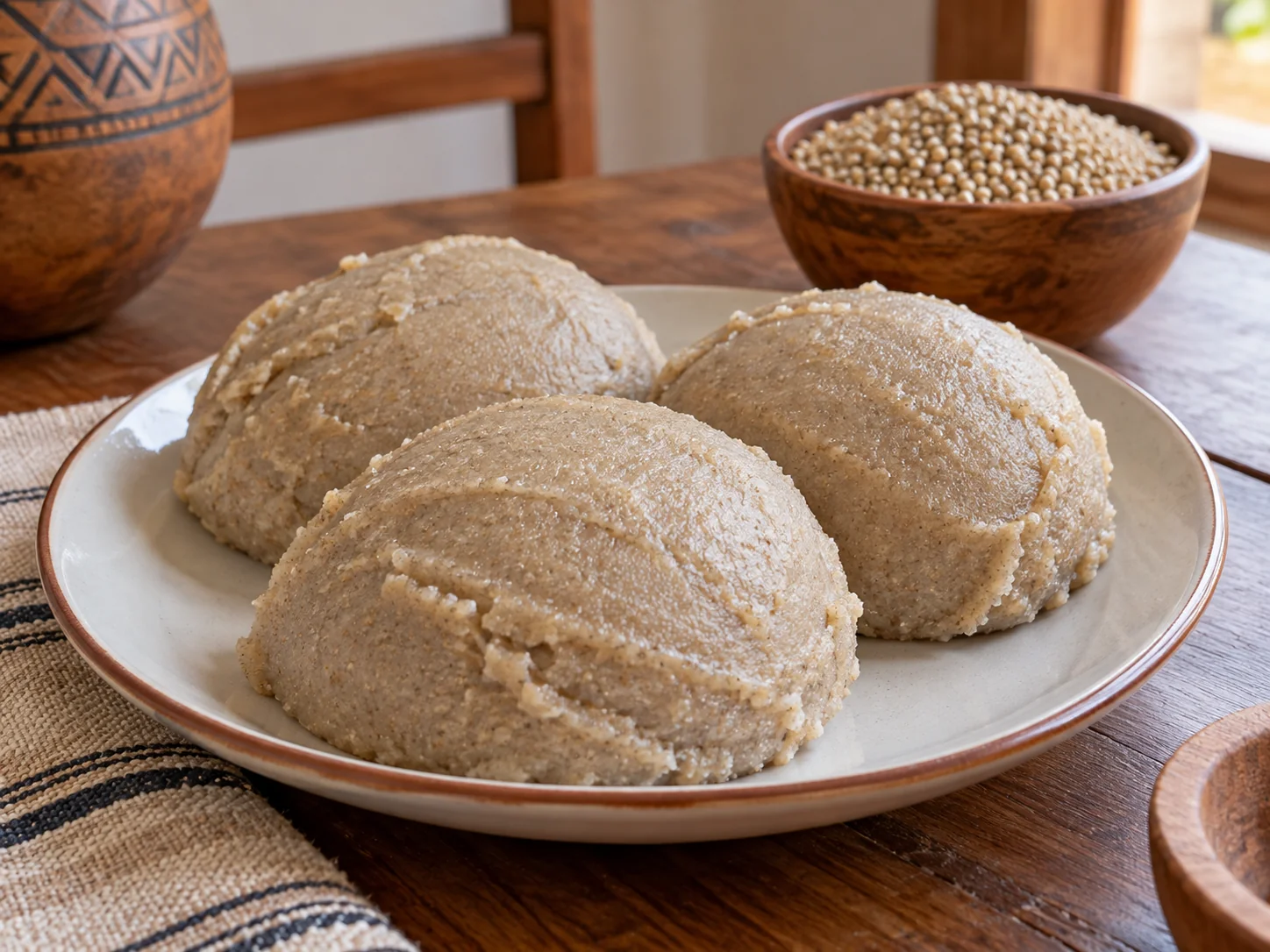
🌾 Tuwo gero is a soft and nutritious millet paste, served with leaf sauces, okra, peanut, cowpea, or meat.
Ingredients
- 🌾 600 g fine millet flour
- 💧 1.8 liters water
- 🧂 1 teaspoon salt
- 🥘 Leaf, okra, peanut, or cowpea sauce for serving
- 🌶️ Fresh chili on the side
Preparation
1️⃣ Dissolve 150 g of flour in 450 ml of cold water.
2️⃣ Bring the remaining salted water to a simmer.
3️⃣ Pour in the pre-cooked mixture while whisking and cook for 6 minutes.
4️⃣ Add the remaining millet in a steady stream, beat, and cook for 15 minutes.
5️⃣ Cover for 8 minutes, then work the paste until smooth.
6️⃣ Form balls with wet hands and serve hot. 🇳🇪
Introduction
🌾 Full Introduction — Millet becomes a paste of sharing. Tuwo gero means millet paste in Hausa usage. Millet, a cereal adapted to Sahelian landscapes, is ground then slowly hydrated until it forms a soft, slightly malty mass, firm enough to scoop up a sauce. The result is neither a porridge nor a bread: it's a warm paste, shaped into balls, whose neutrality highlights the sauce. In this recipe, fine flour provides a regular texture, but a more rustic grind gives an authentic character and simply requires more resting time.
🇳🇪 Historical, Cultural, and Religious Landmarks. Niger is a Sahelian country where cereals, livestock farming, markets, and migrations have shaped very diverse cuisines. Millet, rice, and sorghum respond to different terroirs; their transformation into paste or their drying into thin strips allows a family to be fed despite seasons, distances, and harvest variations. The word tuwo refers to a cooked and worked paste, but the texture, local name, flour, and sauce change according to communities, languages, city, countryside, and family habits. Kilishi, very thin dried and then grilled meat, belongs to another logic: concentrating the meat, flavoring it, and making it transportable. These preparations are not fixed objects. They live in homes, markets, celebrations, travels, and restaurants. 🌾
📜 Transmission and Memory. An experienced person recognizes the right degree of grinding by touch, listens to the sound of the spatula in the paste, knows when the millet has absorbed the water, and observes the color of the kilishi before it hardens. Modern mills, ovens, refrigerators, and urban markets change the tools without eliminating the know-how. The recipes offered here provide measurable benchmarks for contemporary cooking, while leaving room for learning from Nigerien families. A paste can be softer for a child, firmer to accompany a dense sauce, or lighter when a person needs to eat carefully. A slice of kilishi can be spicy, mild, softer, or very dry depending on the weather and the household recipe. 🤝
🕌 Social and Religious Context. Tuwo and kilishi can accompany a daily meal, a visit, a reception, a market, a wedding, a celebration, or a fast-breaking, but neither should be presented as automatically ritualistic for all of Niger. Muslim communities are numerous, and meats must come from a halal source when it aligns with the guests' beliefs. Other families adapt accompaniments to their traditions, fasts, allergies, or budget. Always announce the presence of peanuts, sesame, broth, chili, and meat. Keeping very spicy sauce separate is a sign of hospitality: children, the elderly, and visitors can share the same table without experiencing the same intensity. 🕊️
🧑🏾🍳 Safety and Organization. Store millet, rice, and flours in dry, closed containers protected from insects. For a paste, separate the water for the pre-cooked mixture from that added later, work with a sturdy spatula, and protect yourself from steam. Cool the paste in small portions within two hours, keep it refrigerated for two days, and reheat it with a few drops of water. For kilishi, buy meat prepared by a reliable source or use a controlled dehydrator; never dry raw meat in the sun or at room temperature without a validated method. The meat must be cooked through before or after drying depending on the equipment, then kept cold. A marinade should not be reused. Clean boards, wash hands, and separate raw and cooked. ❄️
🍽️ Balance and Nutrition. A ball of tuwo is primarily a source of energy; combine it with a sauce of leaves, okra, vegetables, cowpea, peanut, or a protein to obtain a more complete plate. Kilishi provides protein, but drying also concentrates salt: serve a measured portion with raw vegetables, vegetables, and water. Bissap, tamarind, ginger, lemon water, and light tea pair well with the dishes; choose low-sugar versions. The calories and nutrients below are estimates per serving, variable depending on the flour, ball size, beef cut, oil, marinade, and sauce. They do not replace medical advice. Each recipe includes duration, steps, variations, accompaniments, drinks, tips, and a conclusion. A ci lafiya! — bon appétit in Hausa. ✨
🌍 Read the recipe as a story. The final taste depends on successive decisions: choosing clean grain, grinding it without heating, measuring the water, listening to the simmering, tasting before salting, and letting it rest. These details make cooking reliable while respecting local differences. A written recipe does not replace the words of an aunt, a neighbor, or a market artisan; however, it can help transmit gestures, indicate allergens, and welcome a new generation around a Nigerien table.
🧑🏾🍳 Detailed Preparation and Chef's Tips. Sift the flour if it contains overly hard husks. The pre-cooked mixture is essential: it hydrates an initial part of the grain and prevents lumps when the rest is added. Pour in a steady stream, never in a lump, and use a long-handled spatula. The heat should remain medium; aggressive boiling burns the bottom before the center cooks. When the paste detaches from the sides, cover it so that the steam finishes the job. If it's too hard, add a ladle of hot water; if it sticks, continue for a few minutes uncovered. Keep the balls covered and serve quickly.
🗺️ Variations, Accompaniments, and Conclusion. A family can mix millet and sorghum, add a small portion of corn, or choose a darker flour. Tuwo gero pairs well with moringa, fakou, okra, peanut-tomato, cowpea, dried fish, or meat sauce. Cucumber, cabbage, tomato, and carrot add freshness. Bissap, tamarind, ginger, or lemon water, low in sugar, are suitable. A portion of paste provides approximately 320 kcal, 9 g protein, 67 g carbohydrates, 3 g fat, 6 g fiber, 250 mg sodium, and 0.63 g salt; millet provides iron, magnesium, phosphorus, and B vitamins, while the sauce complements the proteins. A ci lafiya! ✨
Cultural context
🇳🇪 Millet connects Sahelian agriculture, household economy, and hospitality; tuwo can be daily or festive without being automatically ritualistic.
Tips
💧 Dissolve in cold water.
🥄 Add in a steady stream.
🔥 Beat without burning the bottom.
⏳ Respect the covered resting time.
🌶️ Keep chili separate.
Variations
🌾 Mix millet, sorghum, or corn; choose a fine or rustic grind and adjust the water.
Accompaniments
🥘 Moringa, okra, peanut, cowpea, or meat sauce. 🥤 Bissap, tamarind, ginger, and lemon water.
Nutrition notes
💪 Millet provides fiber, iron, magnesium, phosphorus, and B vitamins; a legume or meat sauce adds protein and micronutrients.