Oha soup / Ofe oha — Igbo soup with oha leaves
🍃 Oha soup, or Ofe oha, is an Igbo soup made with oha leaves, cocoyam, palm oil, meat, smoked fish, and crayfish.
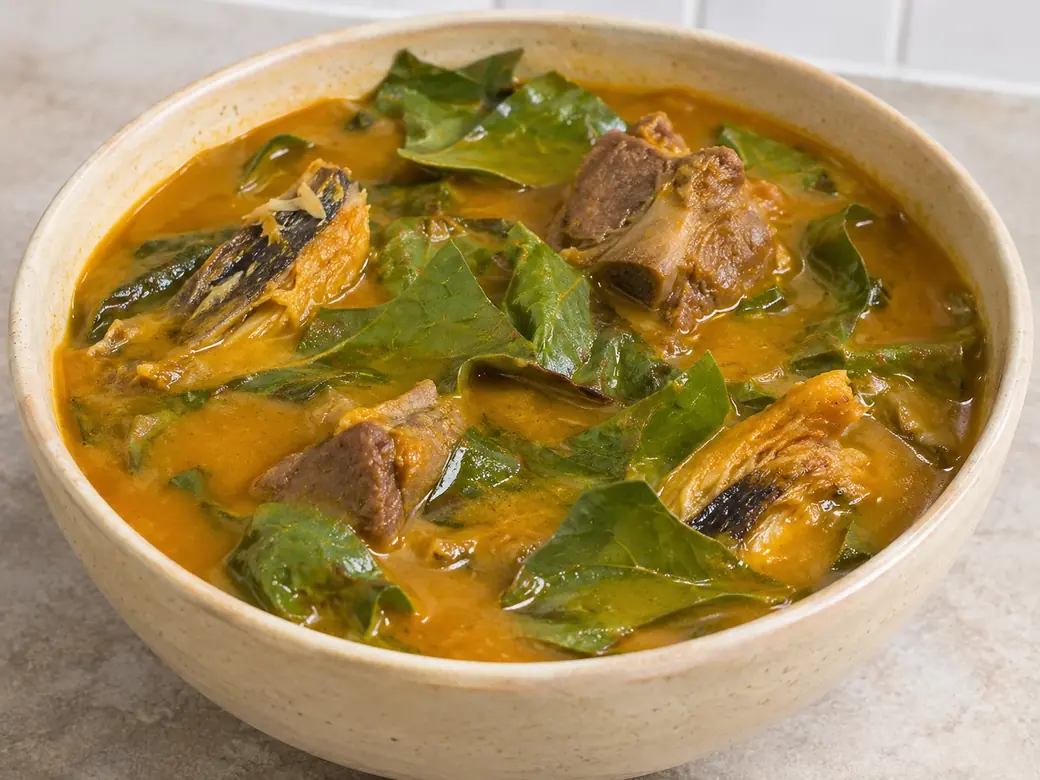
Ingredients
- 🍃 250 g oha leaves, hand-torn, without thick veins
- 🥔 300 g cooked and pounded cocoyam for thickening
- 🥩 600 g beef or goat, cut into pieces
- 🐟 250 g smoked fish, 60 g crayfish, and 150 g rehydrated stockfish
- 🫗 120 ml red palm oil
- 🧅 2 onions, 1 chili, and 2 tablespoons ogiri (optional)
- 💧 Hot broth according to consistency
- 🧂 Salt with caution, especially if the fish is smoked
Preparation
1️⃣ Rinse the oha leaves without chopping them with a knife; remove thick fibers and tear them.
2️⃣ Cook the cocoyam until tender, peel it, then pound it into a smooth paste.
3️⃣ Cook meat and stockfish with onion, pepper, and little water; add smoked fish after checking for bones.
4️⃣ Heat palm oil, sauté crayfish, chili, and ogiri, then incorporate the broth and cocoyam paste.
5️⃣ Add proteins and simmer until a bound sauce is obtained, without lumps.
6️⃣ Incorporate the oha leaves last, cook for five to eight minutes, and adjust seasoning.
7️⃣ Serve with fufu, akpu, eba, pounded yam, or cornmeal. 🇳🇬
Introduction
🍃 Introduction and identity. Oha soup, called Ofe oha in Igbo, is a soup deeply associated with the tables of southeastern Nigeria. It is distinguished by its oha leaves, harvested from a tree whose tender leaves are traditionally torn by hand, and by cocoyam which gives the sauce its velvety binding. The pot often welcomes beef, goat, stockfish, smoked fish, crayfish, and palm oil. The result is fragrant, slightly bitter, rich, and smooth: a soup to be eaten with fufu, akpu, eba, or pounded yam. 🍲
📜 History of ingredients. Cocoyam grows well in humid areas and provides a local thickener that avoids the need for imported flour. Oha leaves are seasonal and can be sold fresh or preserved; their preparation requires special attention to remove overly tough parts. Stockfish and smoked fish tell the story of exchanges between the coast, markets, and the country's interior. Crayfish, pounded, diffuses into the broth and gives a marine depth. Palm oil brings color, fragrance, and energy. This soup is therefore the result of a terroir, a trade network, and patiently built family technique. 🌴
🤝 Igbo transmission. In an Igbo family, the knowledge of Ofe oha is seen in small gestures. One observes how to peel cocoyam without waste, to pound until lumps disappear, to tear oha rather than crush it, and to measure water so that the soup coats the accompaniment. Elders can recognize the right leaf by touch; younger ones learn to taste the stockfish before salting. A large pot can accompany a visit, a wedding, a meeting, a celebration, a Sunday, or a daily meal. The recipe changes with the season, but its principle of generosity remains constant. 🏠
🕊️ Historical and cultural context. Ofe oha is not automatically a ritual dish. Igbo people practice different forms of Christianity, ancestral traditions, secular life, and, depending on the regions, coexist with other religious communities. The soup can be served during a cultural ceremony or simply after a day's work. Before cooking for guests, announce meat, fish, crayfish, stockfish, ogiri, oil, and chili. A version without animal products can use mushrooms, beans, or tofu, but it must be presented as a contemporary adaptation. A family can also choose a halal preparation or reduce smoked ingredients according to their beliefs and needs. 🙏
🥔 The role of cocoyam. Cook the tubers in water until a knife easily pierces them. Peel them carefully while still warm, then pound them in a mortar or mash them very finely. Add the paste by small spoonfuls to the broth so that it dissolves without lumps. Cocoyam that is too cold or poorly pounded will result in heavy pieces; an excessive amount will make the soup compact. The goal is a bound sauce that flows slowly around the paste, not a puree. If the soup thickens during resting, loosen it with hot broth. The quality of the starch is as important as the quantity. 🧑🏾🍳
🍃 Preparing oha leaves. Wash the leaves in several changes of water to remove soil and dust. Remove very thick veins if they are tough, then tear the leaves with your fingers. This gesture avoids too regular a cut and respects a domestic way of preparing oha. Fresh leaves can be added at the end of cooking; frozen leaves must be thawed and drained. Do not cook them for an hour: they would lose their fragrance and color. A slight bitterness is normal and balances the fat of the soup. If the leaves are particularly strong, add them gradually and taste before continuing. 🌿
🔥 Meat and smoked base. Cook the meat with little water, onion, and pepper; keep the liquid for the broth. Stockfish must be soaked and then rinsed according to its saltiness. Smoked fish is checked bone by bone and added without being reduced to crumbs. Heat the palm oil without burning it, then sauté crayfish, chili, and ogiri if you are using it. Incorporate the broth and cocoyam paste, then simmer so that the starch becomes fragrant. Add the proteins and maintain a low heat. The soup should be shiny, bound, and fluid enough to coat the fufu. A brutal boil would cause the cocoyam to stick to the bottom. 🥄
🗺️ Regional and family variations. The proportions of cocoyam and oha change according to Igbo regions and household habits. Some add more meat and stockfish for a festive occasion; others prefer fish and leaves. Ogiri can be present, discreet, or absent depending on taste. Goat brings a stronger note than beef; fresh fish is suitable for a coastal version. In the diaspora, frozen oha leaves, tender spinach, or another local leaf can be a substitute, provided the substitution is explained. Cocoyam can be replaced by a small amount of yam or potato, but the texture and flavor change. The most respectful variation retains the logic: fragrant leaf, concentrated broth, and natural binder. 🌍
🍽️ Accompaniments and drinks. Serve Ofe oha with cassava fufu, akpu, eba, garri, pounded yam, cornmeal, or plantain. The paste should remain simple to allow the delicate bitterness of the oha and the fragrance of the broth to express themselves. A cucumber, tomato, onion, and lime salad refreshes the plate. Zobo, bissap, ginger juice, tamarind, fresh water, and malted drinks work with the warmth of the oil and chili. Present strong condiments separately. For family service, remove large bones and fishbones before placing the pot on the table; everyone can then choose their proportion of meat and leaves. 🥤
💪 Nutrition. A portion of soup, without the accompanying paste, provides approximately 470 kcal, 32 g protein, 24 g carbohydrates, 27 g fat, 6 g fiber, 860 mg sodium, and 2.2 g salt. Cocoyam provides carbohydrates and potassium; oha leaves provide fiber, folate, and vitamins A, C, and K. Meat, stockfish, and fish contribute protein, iron, zinc, calcium, phosphorus, selenium, and B vitamins. Palm oil provides energy and carotenoids: measure it according to need. For a lighter plate, serve less paste, increase the leaves, and use a leaner protein. The figures change according to the smoked ingredients, broth, cocoyam portion, and oil. 🥗
🧼 Safety, storage, and conclusion. Keep raw products refrigerated, separate cutting boards and utensils, cook meat thoroughly, and check all fishbones. Cool the soup within two hours in shallow containers; keep it for two to three days in the refrigerator or freeze it in portions. Reheat gently with a little broth, without letting the cocoyam stick. Ofe oha shows how Igbo cuisines give equal importance to leaves, tubers, preserved products, and sharing. Prepare it with respect, taste gradually, and serve it hot. In Igbo, say “Nri ọma!” — bon appétit, good food! May the soup bring guests together and keep the memory of oha leaves alive. ✨
Cultural context
🇳🇬 Ofe oha is an Igbo soup with oha leaves and cocoyam, enriched with smoked ingredients, crayfish, palm oil, and proteins according to the household.
Tips
🥔 Pound the cocoyam very finely.
🍃 Add the oha last.
🐟 Check every bone.
🧂 Taste the stockfish before salting.
🔥 Maintain a low heat.
Variations
🗺️ Vary beef, goat, fish, stockfish, ogiri, leaves, and binder according to region, season, market, and beliefs.
Accompaniments
🥣 Fufu, akpu, eba, garri, pounded yam, or plantain. 🥤 Zobo, bissap, ginger, tamarind, and fresh water.
Nutrition notes
💪 Energetic cocoyam and leaves rich in fiber, folate, vitamins A, C, K, potassium; proteins rich in iron and zinc.
Conclusion
Serve after checking the centre is fully cooked and the texture is homogeneous.
Enjoy your meal
Enjoy your meal!