Abula
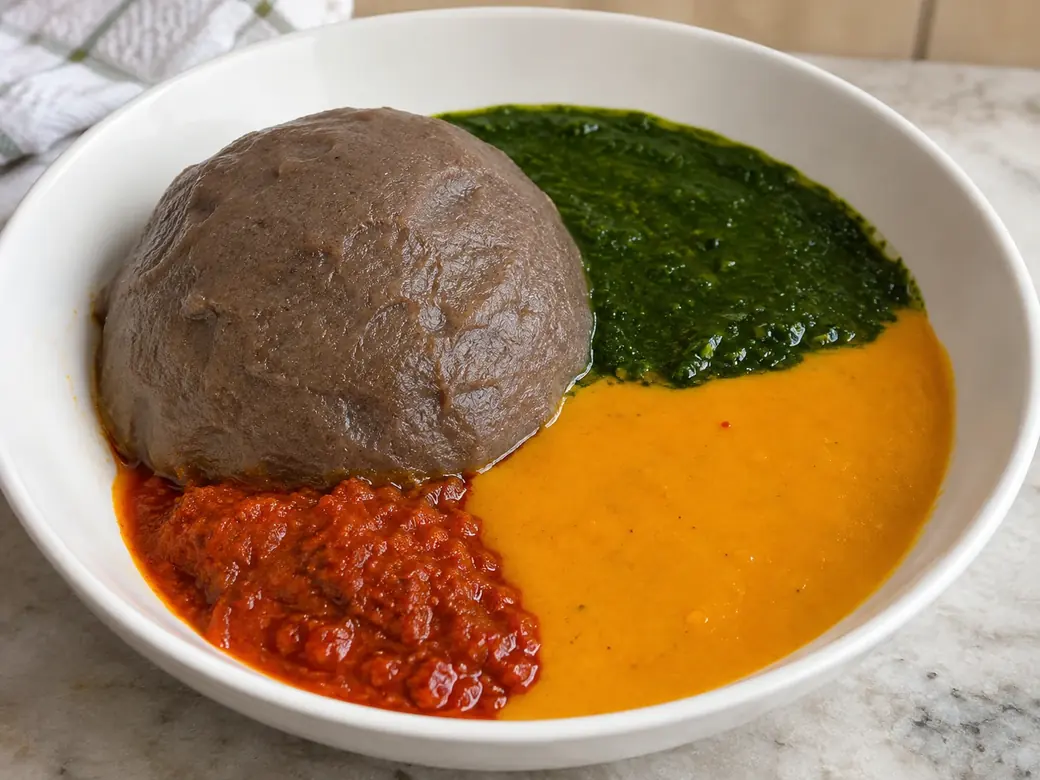
🍲 Abula is the classic Yoruba combination of amala, ewedu, gbegiri, and stew in a generous plate.
Ingredients
- 🟤 500 g amala flour (dried yam) and 900 ml water
- 🌿 400 g prepared ewedu leaves
- 🫘 250 g peeled beans for gbegiri
- 🍅 700 g tomatoes, red bell peppers, onions, and chili for the stew
- 🥩 600 g beef, goat, or chicken, optional
- 🐟 200 g smoked fish or crayfish, optional
- 🫗 120 ml palm oil or neutral oil
- 🧂 Salt and low-sodium broth to taste
Preparation
Prepare the gbegiri: soak and cook the beans, blend them, then season with oil, crayfish, and chili.
Prepare the ewedu: cook the leaves for a few minutes, pound or blend them, then keep them warm.
Prepare the stew: reduce tomatoes, peppers, onions, and chili, then add the cooked protein and oil.
Bring the amala water to a boil, gradually pour in the flour, and stir vigorously until a smooth paste is obtained.
Cook and work the amala over low heat, adding a little water if necessary, then form portions.
Serve all four elements together, hot, with drinks and condiments separately. 🇳🇬
🧑🏾🍳 ORGANIZATION OF THE FOUR PREPARATIONS. Start with the beans, as they take the longest. While they cook, prepare the stew and protein. The ewedu should be made towards the end to keep its green color and freshness. Amala is prepared just before serving: a paste that waits too long can firm up and lose its elasticity. Reserve clean pots, separate spoons, and a bowl of hot water. Taste each element separately and then together, as a salty stew can make the whole dish too salty. Keep meats and fish refrigerated until cooking and check for bones. 🧼
🔥 TIPS FOR AMALA. Bring water to a boil, gradually pour in the flour, and stir with a sturdy spatula. Add flour gradually to control density. A successful paste is smooth, pliable, slightly elastic, and free of dry lumps. Cover for a few minutes over very low heat, then work it again. If it becomes too firm, incorporate a small amount of hot water; if it's too soft, continue cooking while stirring. Not all flours absorb the same amount of water: observe rather than blindly follow a number. Lightly oil the spoon if the paste sticks. 🟤
🌿 BALANCING EWEDU AND GBEGIRI. Ewedu should remain vibrant, green, and viscous; cook it briefly then blend it with little liquid. Gbegiri should be velvety and smooth, never grainy or burnt. A pinch of food-grade potash can be used in ewedu depending on the family, but it is optional. The crayfish in gbegiri and the fish in the stew can add a lot of salt: taste before adjusting. Both soups benefit from being kept over very low heat, with a little hot water on hand. Do not let them boil for long, as they would thicken and lose their texture. 🍲
🍅 MASTERING THE STEW. Blend tomatoes, peppers, onions, and chili, then reduce the base before adding the oil. Patient reduction removes excess water and raw taste. Palm oil gives a deep color; a neutral oil offers a lighter version. Meat, chicken, goat, or smoked fish should be cooked separately or added at the right time to avoid drying out. Chili can remain discreet for a family table and be offered separately. A well-reduced stew adheres to the paste without making it soggy and maintains a balanced acidity. 🌶️
🕐 Preparation: 45 min 🔥 Cooking: 1h 30 min ⏱️ Total: 2h 👥 Servings: 6 people
Introduction
🇳🇬🍲 ABULA refers to a much-loved combination in Yoruba cuisine: amala, ewedu, gbegiri, and stew, all brought together on one plate. It's not a single soup, but a composition where each element plays a role. Amala, a dark and pliable paste made from dried yam flour, serves as the base. Ewedu provides a green, viscous soup. Gbegiri offers a cream of peeled beans. The red stew, flavored with tomato, bell pepper, onion, and chili, adds depth, warmth, and substance. A bite can be very mild or very lively depending on the chosen proportion. 🥄
🕊️ CULTURAL AND RELIGIOUS CONTEXT. Christian, Muslim, traditional, and secular communities in Nigeria have diverse customs. Abula is not a religious obligation and should not be presented as automatically sacred. One family might serve it during a celebration, a festive meal, or a cultural ceremony; another eats it on an ordinary day. The stew can be prepared with halal meat, fish, egg, mushrooms, or no animal products. Crayfish, potential peanuts, broth, oil, smoked fish, and chili should be noted. Respecting a fast, an allergy, or a preference is an essential part of hospitality. 🙏
Cultural context
📜 HISTORY, MARKET, AND TRANSMISSION. Abula is part of the stories of yam, beans, leaves, and sauces that nourish southwestern Nigeria. Yam is stored then processed into flour, dried beans withstand transport, jute leaves grow in gardens, and tomatoes or chilies circulate through markets. The combination shows the intelligence of a table that combines complementary textures and varied energy sources. The techniques are learned from a mother, father, grandmother, vendor, or canteen cook: stirring amala without lumps, pounding ewedu, smoothing gbegiri, and reducing the stew without burning it. 🌾
🤝 A SHARING PLATE. In a home, Abula can be prepared for a family after work, a Sunday lunch, a visit, a party, a wedding, or a neighborhood gathering. In Yoruba restaurants and canteens, the four elements are served quickly, but their preparation requires good organization. Service can be on individual plates or a large platter. The person eating takes a small portion of amala and dips it into the soups; it is also possible to use a spoon. Generosity is measured by the quality of the texture and the attention paid to guests, not just the quantity of meat. 🍽️
Tips
⏳ Prepare the beans first.
🟤 Work the amala with hot water.
🌿 Keep the ewedu green.
🍅 Reduce the stew before adding oil.
🧂 Taste each element separately.
Variations
The name Abula evokes a whole, but proportions change. One family might prefer more ewedu, another more gbegiri; a canteen might serve a very spicy stew, another a mild sauce. Amala can be prepared with yam flour, plantain, or another flour depending on the market. Beef can become goat, chicken, fish, or mushroom. Frozen leaves can replace fresh ones in the diaspora; black-eyed peas can replace honey beans. These adaptations should be honestly announced: they extend the cuisine without erasing the Yoruba versions. 🌍
Accompaniments
🥗 SERVICE AND CONVIVIALITY: Serve the amala in a ball or in portions, place the ewedu and gbegiri side by side, then add the stew on top or in a small compartment. A hot plate keeps the textures. Cucumber, tomato, onion, cabbage, avocado, and lime bring freshness. 🥤 DRINKS: Lightly sweetened zobo, bissap, ginger juice, tamarind, fresh water, and malted beverages pair very well. Beer may be suitable for a festive table for adults who consume it, but water remains essential with chili. Present sauces separately to children and guests who prefer to portion each bite.
Nutrition notes
💪 A complete portion of Abula, with a moderate portion of amala and a meat stew, provides approximately 690 kcal, 88 g carbohydrates, 24 g fats, 31 g protein, and 13 g fiber, with about 920 mg sodium and 2.3 g salt. Beans provide fiber, folate, iron, potassium, and plant proteins; leaves contribute vitamins A, C, and K; meat or fish provide iron, zinc, B12, and selenium; amala provides the necessary energy. The numbers change with the oil, paste, broth, and protein. Cool each element within two hours, store them separately for two to three days, and reheat them only once.
Conclusion
Serve after checking the centre is fully cooked and the texture is homogeneous.
Enjoy your meal
Enjoy your meal!