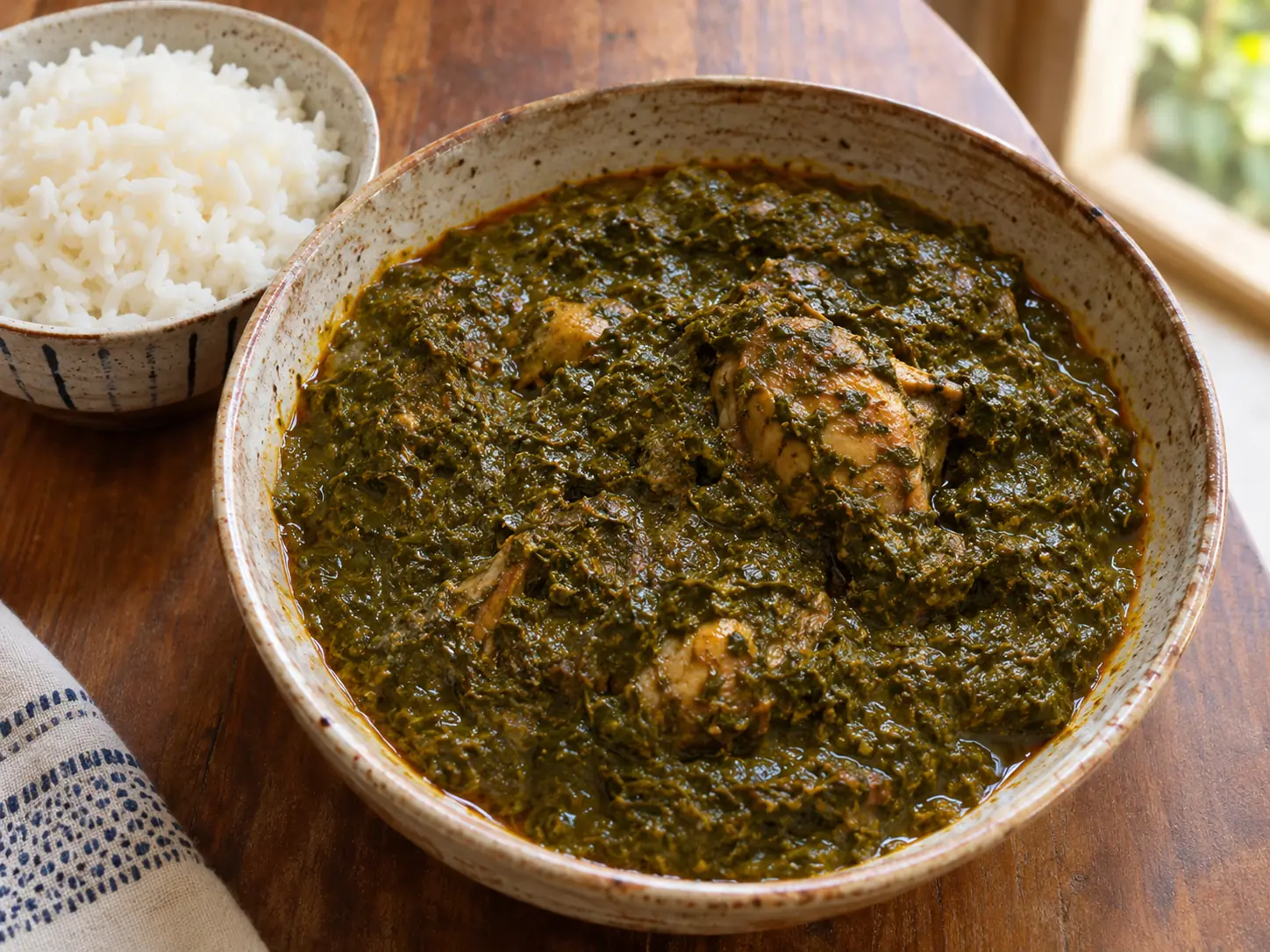
Cassava leaf with peanut butter — feuilles de manioc à la pâte d'arachide
🥜🌿 Creamy cassava leaf and peanut butter sauce, flavored with chili, tomato, and Sierra Leonean aromatics.
Ingredients
- 🌿 1 kg blanched, drained, and finely pounded cassava leaves
- 🥜 180 g 100% peanut butter, unsweetened, diluted in 300 ml hot water
- 🍗 500 g chicken or 400 g smoked fish, optional
- 🧅 2 onions, 🧄 5 cloves garlic, and 🫚 25 g ginger
- 🍅 300 g crushed tomatoes and 1 tablespoon tomato paste
- 🫗 60 ml palm oil or neutral oil
- 🌶️ 1 whole chili, pepper, and salt with caution
- 💧 900 ml hot water, lime, and white rice for serving
Preparation
1️⃣ Prepare and blanch leaves for 30 minutes; drain and pound finely.
2️⃣ Brown chicken if used. Sauté onion, garlic, and ginger in oil, then reduce tomato for 10 minutes.
3️⃣ Add leaves and 500 ml water. Cover and cook for 35 minutes over low heat.
4️⃣ Dilute peanut butter in hot water until smooth, then gradually incorporate.
5️⃣ Add chicken or fish, chili, and remaining liquid. Simmer for 25 to 30 minutes, stirring often.
6️⃣ Taste, adjust salt, finish with lime, and let rest for ten minutes. Serve with **Wɔ́n fɔ́ it!** 🇸🇱
Introduction
🥜🌿 The enriched version with peanut butter. 🌿 Introduction, history, and transmission. Cassava leaves, known as cassava leaf in many English-speaking exchanges and plasas in several Sierra Leonean families, are one of West Africa's great vegetable preparations. They require time, attention, and thorough cooking: their appeal comes not only from their green color but from the transformation of a fibrous leaf into a smooth, deep, and fragrant sauce. Depending on the market, fresh, pounded, chopped, or frozen leaves can be purchased. Each format slightly changes the amount of water and the time required. Family cooking precisely observes this texture, listens to the simmering, and tastes for bitterness before proceeding. 🧑🏾🍳
📜 Historical context. Cassava was spread to tropical regions through Atlantic trade routes, then adopted and transformed by farmers and cooks. This history of circulation does not diminish its Sierra Leonean identity: communities selected varieties, perfected pounding techniques, and combined the leaves with palm oil, chili, onion, smoked fish, meat, and available grains. A pot of cassava leaf thus tells the story of connections between gardens, markets, coasts, rivers, cities, and the diaspora. Names change according to language, region, and family; there is no single mandatory formula. 🌍
🏠 Daily life and hospitality. In Sierra Leone, a leaf sauce can feed a large family with white rice, complement a weekday meal, or become the generous centerpiece of a gathering. The cook adjusts the salt according to the smoked fish or broth, the oil according to the budget, and the chili according to children and guests. The table is built on contrasts: a rich green sauce, neutral rice, a vibrant condiment, and a cool drink. Serving elements separately allows everyone to compose their plate and respect dietary preferences. 🤝
🕊️ Cultural and religious context. Sierra Leonean households bring together Muslim, Christian, traditional, and family practices. Cassava leaf is not automatically a ceremonial dish or a religious prescription. It can be prepared on an ordinary day, for a visit, a celebration, a community gathering, or after a period of fasting, with adaptations chosen by the family. The presence of fish, smoked ingredients, beef, palm oil, peanuts, and broth must be announced. A meat-free version may suit some tables, while a Muslim family will choose halal meat if they use it. 🙏
🧼 Preparation and safety. Wash the leaves thoroughly, remove tough stems, and pound them very finely. Never taste raw leaves: they must be prepared and cooked long enough according to the product used. Keep meat and fish cold, separate cutting boards, wash hands, and check for bones. Smoked fish is already salty; add salt gradually. A leaf sauce should simmer gently until all raw texture disappears and the taste is well-rounded. Cool leftovers within two hours in shallow containers, refrigerate for two or three days, and reheat only once until steaming hot. ❄️
🫗 The aromatic base. Onion, garlic, ginger, chili, pepper, and tomato can form the starting point, but tomato is not mandatory in every household. Red palm oil adds color and character; a neutral oil gives a visually lighter sauce. Sauté the aromatics without burning them, then let the leaves release their water and absorb the base flavors. Add liquid in small quantities: too much water dilutes the flavor, too little causes sticking. Peanut butter can thicken and round out the sauce, but it increases calories and must be announced to guests. 🔥
🍚 The role of rice. White rice accompanies the sauce because it absorbs its juices without competing with the leaves. Rinse it, measure water according to the variety, and let it rest covered before fluffing. A portion of sauce and a reasonable portion of rice make a satisfying plate; add cucumber, tomato, cabbage, avocado, lime, or cooked vegetables for freshness and fiber. Boiled plantain, cassava, yam, bread, or grain paste are other possible bases. The right side dish is one that allows the sauce to remain distinct. 🍽️
🗺️ Regional and diaspora variations. On the coast, fresh fish, smoked fish, or shrimp can enhance the seafood character. Inland, beef, chicken, beans, or a vegetable preparation can take over. Some families pound the leaves until creamy, others retain some chewiness. You can substitute a hard-to-find oil, choose a mild chili, or add lemon at the end, without claiming these choices are universal. The diaspora adapts ingredients to the local market while preserving the techniques: finely prepared leaves, patient cooking, gradual seasoning, and serving with a neutral base. 🌿
👩🏾🍳 Chef's tips. Prepare all bowls before heating the pot. A spoonful of leaves cooked separately allows checking for bitterness and texture. Reduce before adjusting salt; add smoked ingredients or meat when the base is already fragrant. For a glossy sauce, use gentle heat and stir from bottom to top. If it thickens too much, add hot water rather than cold. If it's too liquid, remove the lid and reduce without suddenly increasing the heat. Let it rest for five to ten minutes before serving: salt, oil, and spices distribute better. ✨
💪 Nutrition and general conclusion. The leaves provide fiber, carotenoids, vitamin C, vitamin K, and folate, while fish or beef adds protein, iron, zinc, and B vitamins. Figures vary greatly with the amount of rice, oil, peanut butter, and smoked ingredients; therefore, the estimates on each sheet are indicative and do not replace medical advice. For a balanced plate, serve a measured portion of rice, a generous portion of leaves, an appropriate protein, and a raw vegetable. A well-cooked sauce, announced seasoning, and a table open to everyone's choices honor this cuisine of sharing. In Krio, say warmly “Wɔ́n fɔ́ it!” — bon appétit! 🇸🇱
Peanut butter immediately changes the personality of the sauce. It provides a velvety texture, a roasted sweetness, and an ability to bind the liquid around the leaves. Use a butter made only from peanuts, without sugar or hydrogenated oil if possible. Already salted or sweetened butter can unbalance the pot; check the label and reduce salt. This version is denser and more caloric than the leaf sauce alone, but it can also be very satisfying with a small amount of rice and plenty of fresh vegetables. 🥜
🧺 Preparing the leaves and peanuts. Sort, wash, and blanch the leaves before pounding them. Thorough cooking is essential; never taste them raw. Dilute the peanut butter in hot water in a separate bowl. Hot water loosens the butter, prevents lumps, and allows you to check if it already contains salt. Do not pour a compact mass directly into the pot: it would stick to the bottom before dispersing. Leaf preparation can be done the day before if they are cooled quickly; keep them cold and use a clean container. 🧼
🍅 Aromatics and cooking order. Sauté the onion before adding garlic and ginger. The tomato should reduce until it loses its watery sensation. If using chicken, brown it briefly and cook it in the base before the peanuts; if choosing smoked fish, incorporate it later to preserve pieces and control salt. The leaves go in before the butter so they soften and their vegetable flavor blends with the tomato. This sequence yields a balanced sauce: the acidity of the tomato mellows, the peanut butter rounds it out, and the leaves remain recognizable. 🔥
🥄 Incorporating the butter without sticking. Pour the diluted peanut butter in a stream while stirring. The sauce thickens quickly. Maintain a low heat and add the remaining hot water in small quantities. A strong boil separates the peanut oil, concentrates the bottom, and can produce a sticky layer that is difficult to recover. Stir regularly, especially in the first fifteen minutes. The final texture should be creamy but fluid: it should coat the rice, not become a compact paste. If a film of oil appears, it is not necessarily a defect; remove the excess or mix gently after lowering the heat. Let it rest for ten minutes for the sauce to stabilize. ⏳
🕊️ Social and cultural context. A peanut leaf sauce can feed a family, host neighbors, accompany a celebration, or be a weekday meal. It is not automatically linked to a ceremony. Sierra Leonean households combine Muslim, Christian, traditional practices, and family habits; choices of chicken, fish, broth, and peanuts are made according to those present. Clearly indicate peanuts: an allergy can be serious. Avoid any spoon shared with another sauce and offer a peanut-free portion in a separate pot if necessary. Hospitality begins with this consideration. 🤲
🗺️ Regional and diaspora variations. Some families use more leaves and less tomato, others add okra, eggplant, beans, or smoked fish. Chicken, beef, fish, and mushrooms do not require the same cooking time. A vegetarian version with beans or mushrooms becomes nourishing without meat; a redder version adds palm oil; a mild version keeps the chili whole. In the diaspora, jarred peanut butter and frozen leaves are convenient, but water needs adjustment: frozen leaves sometimes release more liquid. The best adaptation retains the gesture of diluting, gentle heat, and the clear taste of the leaf. 🌿
🍚 Sides, drinks, and storage. Serve with white rice, brown rice, plantain, yam, cassava, bread, or corn paste. A salad of cucumber, tomato, cabbage, avocado, and lime provides a crunchy and tangy contrast. Water, ginger juice, tamarind, bissap, or lightly sweetened lemongrass balance the peanut butter. Cool the sauce within two hours, store it in shallow containers in the refrigerator for two to three days, and keep the rice separate. Reheat over low heat with a little water, stirring until steaming hot; reheat only once. Discard the preparation if its smell or texture is unusual. ❄️
💪 Nutrition and conclusion. With rice and chicken, a portion provides approximately 690 kcal, 35 g protein, 80 g carbohydrates, 27 g fat, 9 g fiber, 720 mg sodium, and 1.8 g salt. Peanuts provide plant protein, magnesium, niacin, and vitamin E; chicken adds B6, B12, phosphorus, and selenium; leaves provide fiber, vitamins A, C, K, folate, iron, and potassium. Calories depend on the amount of peanut butter, oil, and rice, and these values remain indicative. A measured portion, raw vegetables, and gradual seasoning make the sauce rich but balanced. The conclusion lies in the action: dilute patiently, cook the leaves sufficiently, and announce the allergen. In Krio, finish with “Wɔ́n fɔ́ it!” — bon appétit! 🇸🇱✨
Cultural context
🥜 Peanuts thicken and enrich Sierra Leonean leaf sauces. This version can be family-style, festive, or vegetarian; peanuts must always be announced to protect allergic individuals.
Tips
🥜 Choose unsweetened peanut butter and dilute it with hot water.
🌿 Cook the leaves before the peanut butter.
🔥 Maintain low heat and stir the bottom.
⚠️ Announce the allergen and separate utensils.
🫗 Add hot water gradually.
Planning
1️⃣ Prepare and blanch leaves for 30 minutes; drain and pound finely. 2️⃣ Brown chicken if used. Sauté onion, garlic, and ginger in oil, then reduce tomato for 10 minutes.
Variations
🌿 Choose chicken, smoked fish, beans, or mushrooms; add okra, eggplant, or palm oil. Prepare a separate pot without peanuts in case of allergies.
Accompaniments
🥗 White rice, plantain, yam, cassava, cucumber, cabbage, avocado, and lime. 🥤 Ginger, tamarind, bissap, lemongrass, or fresh water.
Nutrition notes
💪 With rice and chicken: approximately 690 kcal, 35 g protein, 80 g carbohydrates, 27 g fat, 9 g fiber, 720 mg sodium, and 1.8 g salt. Peanuts: protein, magnesium, niacin, vitamin E; leaves: fiber, A, C, K, folate, iron, and potassium.
Conclusion
6️⃣ Taste, adjust salt, finish with lime, and let rest for ten minutes. Serve with Wɔ́n fɔ́ it! 🇸🇱
Enjoy your meal
Enjoy your meal!