Basbousa
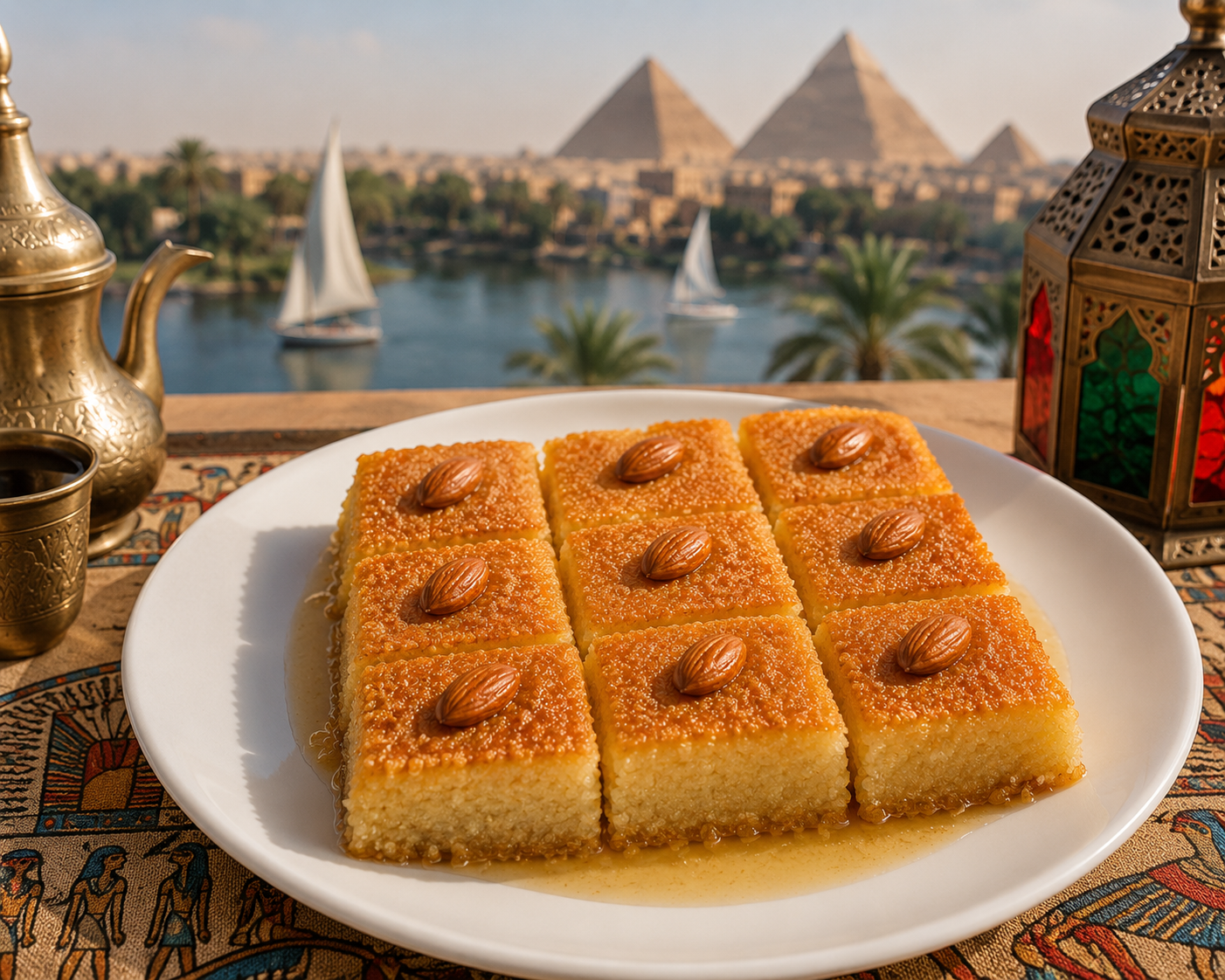
A syrup soaked semolina sweet well represented in Egyptian cooking. Its moist, granular structure differs from an airy flour cake.
Definition
A syrup-soaked semolina sweet well represented in Egyptian cooking. Its moist, granular structure differs from an airy flour cake.
Name and scope
Semolina forms a pastry crumb with perceptible grains. Basbousa names the finished sweet, not the cereal itself. This entry focuses on Egyptian versions.
Cultural context and records
Egyptian baker Cleobuttera documents both a pastry-shop version and a contemporary toasted-milk-and-cream adaptation. They show a classic alongside reinterpretations, without establishing an invention date or a single origin story.
Characteristic skills
Working the semolina and controlling its relationship with syrup shape the texture. The dictionary explains that transformation; quantities, temperatures and sequences belong in a particular recipe.
Flavour and texture
Tasting cues combine sweetness, moisture and fine grain. Buttery, nutty or floral accents may appear. Density and tenderness are separate observations: a soft portion need not be an airy one.
Uses and distinctions
Basbousa is cut into portions. Namoura, revani and sweets called harissa are related comparisons, not universal synonyms. North African chilli harissa is a different food: context prevents confusion.
Explore further
For ingredients, quantities and preparation, see the recipe. This is an independently written dictionary entry.
Sources and review
Cleobuttera — Egyptian pastry-shop basbousa
Cleobuttera — Une variante contemporaine à la crème
2026-11-18