Souma
A Burkinabè dish of cooked Bambara groundnuts (Vigna subterranea); the Mooré word also names the ingredient and should not be confused with cowpea based benga.
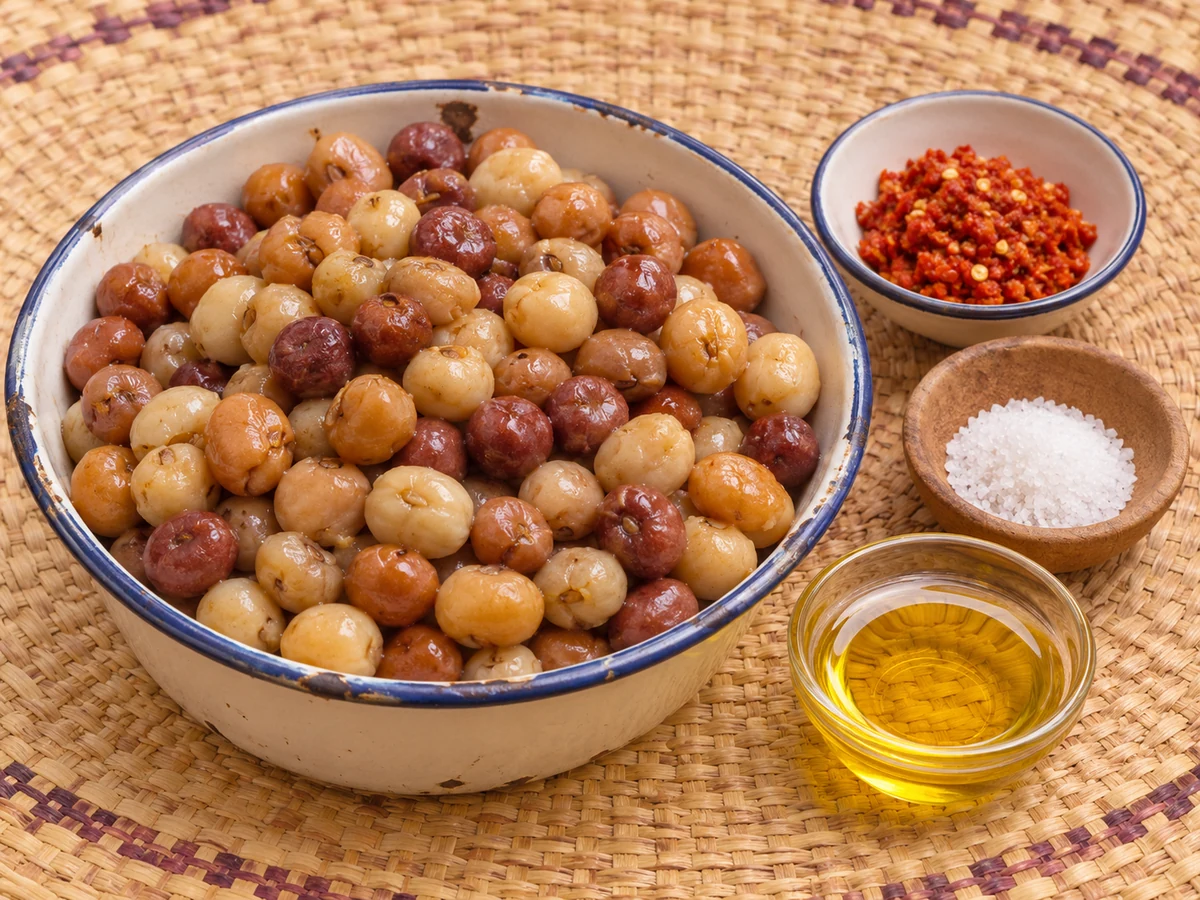
Souma: from Bambara groundnut to cooked dish
In Burkina Faso, souma is a Mooré name for Bambara groundnut, Vigna subterranea, also called earth pea or Bambara bean in English. The same word commonly names the simple dish made by cooking its seeds. This double meaning, ingredient and preparation, helps explain why some publications loosely translate souma as a bean or a “bean dish”. The botanical identity is more precise: Bambara groundnut is an African pulse whose pods develop underground. In this glossary entry, Souma means the Burkinabè dish of cooked seeds; Bambara groundnut remains the ingredient name and does not imply one universal recipe.
A dish distinct from benga
Souma should not be treated as a synonym for benga. In Studio Yafa’s field report from Ouagadougou, vendors and customers distinguish the two pots: benga is made with cowpea or beans, whereas souma is made with Bambara groundnut. The observed serving is deliberately simple: cooked seeds with oil, salt and chilli, sometimes with fish bought separately. These accompaniments document one urban practice rather than mandatory ingredients. The sources establish an affordable, filling street food sold in popular neighbourhoods, but they do not establish an invention date, one national formula, or an exclusive origin in a single city.
Regional names and variation
A Burkinabè study of 138 seed samples and 322 Vigna subterranea accessions records souma and soum moaga among Mossi speakers, alongside other names in several languages of Burkina Faso. It also documents extensive variation in seed colour, size and local morphotype names. That agricultural diversity makes an overly narrow visual definition unsafe: cooked seeds may be cream, brown, red or mottled, and cooking time changes with variety, drying and soaking. Súma is retained as a diacritic spelling variant, while names recorded in other language communities are not automatically made synonyms of the Mooré dish without culinary evidence for each usage.
What the 2026 food-safety study shows
The study published on 14 November 2026 analysed 180 samples from six street-food categories in Ouahigouya, including 30 Souma samples. It grouped Souma with near-neutral solid foods and measured a high mean microbial load in the sampled setting. However, it found no significant difference in bacterial indicators between the six categories and did not link hygiene observations to each vendor’s food sample. The results therefore do not show that Souma is riskier than other foods and cannot be generalised to all of Burkina Faso. Its firm glossary contribution is recent evidence that the name identifies a high-volume product in Ouahigouya; the safety findings remain local context supporting good water, cooking and serving practices.